Why do drivers need a PCO licence in the UK?
April 21, 2026
How Does Airport Meet and Greet Work?
June 11, 2026What is The Difference Between Taxi and Private Hire
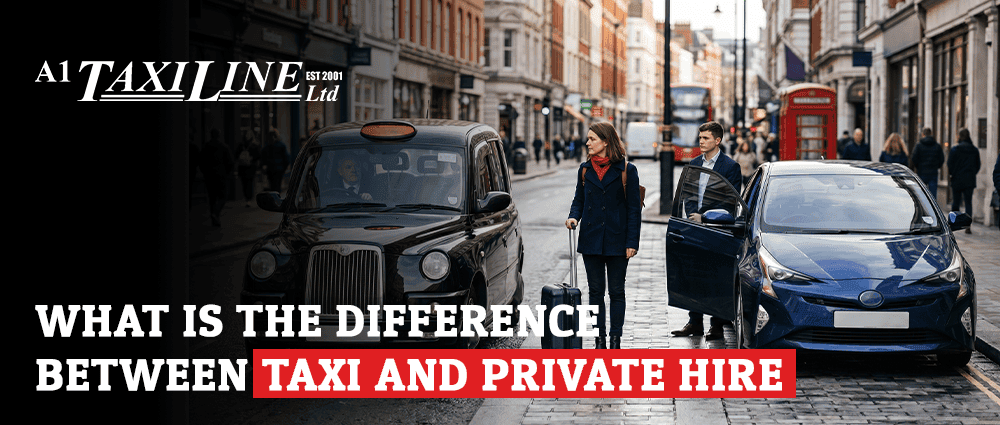
Most people use the terms “taxi” & “private hire” interchangeably, but they are actually two different types of transport with different rules, licensing requirements and ways of getting a ride. Getting this wrong can cost you time, money, or in the worst case, your safety.
Most guides on this topic focus on price alone. This one covers what actually matters when choosing between the two, including how each is regulated, where they can operate, and which one fits your situation better.
A taxi is a licensed vehicle that can be hailed on the street, pick up passengers from a taxi rank, or be pre-booked. A private hire vehicle, often called a minicab, can only pick up passengers who have booked in advance through a licensed operator. That single distinction shapes everything else about how they work.
How each service actually works
Taxis and private hire vehicles may look similar on the road, but the way they operate is different. A taxi driver can respond to a street hail or wait at a designated rank. Private hire drivers, on the other hand, cannot legally stop for someone waving them down.
Every trip they complete must be arranged through a licensed operator who takes the booking, assigns the driver and records the journey. A PHV operator acts as the intermediary between the passenger and the driver. Without a licensed operator in the chain, the trip cannot legally take place.
Taxi vs Private Hire Comparison
Understanding the differences at a glance makes it easier to choose the right option depending on your situation.
| Category | Taxi | Private hire vehicle |
| Licensing | Hackney carriage licence required | Private hire vehicle licence & operator licence required |
| Driver test | Knowledge test (e.g. The Knowledge in London) | DBS check, medical, local authority assessment |
| Fares | Metered and calculated at the end | Fixed at booking |
| Availability | At ranks, streets & through apps | Website, app and phone bookings only |
| Regulatory body | Transport for London (TfL) | Transport for London (TfL) |
| Safety | Visible ID & regulated operation | Booking records & licensed drivers provide traceability |
Taxi Regulations in London
Taxi licensing rules and regulations are some of the most detailed in the UK. Black cab drivers must pass a test that can take several years to complete and requires memorising thousands of routes and landmarks across the city.
Private hire vehicle regulations in the UK require operators to hold a licence from their local authority. Drivers must also be separately licensed since the two licences are not interchangeable.
Taxi rank rules in the UK also differ by area. Councils designate specific taxi rank locations where only licensed hackney carriages may wait for passengers. Private hire vehicles are not permitted to use these ranks, even if they are empty.
Taxi vs Private Hire Benefits
Choosing between the two often comes down to your circumstances. Here is a straightforward breakdown of what each option tends to offer.
Taxi Cars
- Instant availability
- No need to pre book
- Regulated pricing for transparency
- Ideal for short, spontaneous trips
Private Hires
- Fixed pricing with no surprises
- Pre planned convenience
- Wider vehicle choices (including executive cars)
- Better suited for airport and long distance travel
Comparison between the two often comes down to spontaneity versus planning. Taxis suit situations where you need something now. Private hire suits situations where you want everything confirmed ahead of time.
One thing worth knowing: private hire services typically offer fixed pricing agreed at the point of booking, so there are no surprises at the end of a journey. Taxis use a meter, which means the fare can change based on traffic or route.
Availability of the two depends on the time of day and location. In busy urban areas, taxis are often easy to find during peak hours. In quieter areas or late at night, a pre booked private hire is usually the more reliable option.
For those in Buckinghamshire, minicabs in Chalfont offer a practical alternative to waiting for a street cab in an area where taxi ranks are limited.
Conclusion
The biggest misconception is that the difference between taxi and minicab is purely a price debate. In reality, the differences go deeper. Advantages of minicabs over taxis include fixed fares, the ability to book ahead, and the added accountability of a licensed operator overseeing every trip.
Neither option is universally better. The right choice depends on when you need the ride, where you are, and how much planning you have done in advance.
Frequently asked questions (FAQs)
1. Where can taxis legally pick up passengers?
Licensed taxis can pick up passengers who hail them on the street, from designated taxi ranks, or from pre-arranged bookings. Private hire vehicles cannot do any of these without a prior booking through a licensed operator.
2. Are taxis regulated differently from private hire vehicles?
Yes. Taxis are licensed as hackney carriages and can ply for hire in public. Private hire vehicles require both a vehicle licence and an operator licence, and every journey must go through a licensed operator.
3. Is a private hire licence the same as a taxi licence?
No. They are separate licences issued by local authorities. A driver holding only a private hire licence cannot legally work as a taxi driver, and vice versa.
4. What is the role of a private hire operator?
A private hire operator takes bookings, assigns drivers to jobs, and is legally responsible for ensuring all drivers and vehicles in their network are properly licensed. No private hire journey can legally take place without an operator in the process.
5. Do private hire vehicles offer fixed pricing?
In most cases, yes. The fare is agreed at the point of booking, so passengers know what they will pay before they get in the car. Taxis use a meter, which can vary based on traffic and distance.
6. Can taxis be booked in advance like private hire vehicles?
Yes, many taxi firms accept advance bookings. However, unlike private hire, taxis can also be hailed on the spot without any prior arrangement.
7. Are taxi services available 24/7 in all areas?
Not always. Availability depends on the area. In city centres, 24-hour taxi services are common. In smaller towns or rural areas, pre-booked private hire is often more reliable for late-night or early-morning travel.